


When purchasing steel products for concrete reinforcement, you may see ASTM listed in project specifications, product documentation, or quality requirements. But what does ASTM mean, and why is it important?
ASTM standards provide a common technical framework for evaluating materials, products, and manufacturing processes. For example, for Welded Wire Reinforcement, these standards help engineers, contractors, precast manufacturers, and procurement teams confirm that the specified reinforcement meets established requirements.
Understanding ASTM can help buyers make informed sourcing decisions and reduce uncertainty before materials arrive at the jobsite.
What Is ASTM?
ASTM International is a global organization that develops voluntary consensus standards for materials, products, systems, and services.
Originally known as the American Society for Testing and Materials, the organization adopted the name ASTM International in 2001 to reflect its global reach. Today, more than 13,000 ASTM standards are used across industries such as construction, manufacturing, energy, transportation, and infrastructure.
These standards are developed through a collaborative process involving engineers, manufacturers, researchers, government representatives, and other technical experts.
ASTM standards may define:
- Material properties
- Product dimensions and tolerances
- Manufacturing requirements
- Testing procedures
- Performance expectations
- Terminology and classifications
- Inspection and reporting methods
ASTM does not manufacture products or approve individual projects. Instead, it provides technical standards that allow companies and project teams to evaluate products using consistent criteria.
Are ASTM Standards Required?
ASTM standards are considered voluntary consensus standards. However, they can become contractual or regulatory requirements when they are referenced in:
- Construction documents
- Engineering specifications
- Purchase orders
- Building codes
- Government regulations
- Industry requirements
If a project specifies a particular ASTM standard, the supplied material must meet the applicable requirements of that standard.
This is why procurement teams should review the full project specification before ordering reinforcement. Wire size, spacing, configuration, material properties, and applicable standards must align with the engineer’s requirements.
What Is ASTM A1064?
ASTM A1064/A1064M is the primary ASTM specification for carbon-steel wire and Welded Wire Reinforcement used in concrete.
Its full title is:
Standard Specification for Carbon-Steel Wire and Welded Wire Reinforcement, Plain and Deformed, for Concrete
The specification applies to steel wire produced from hot-rolled rod and used to manufacture concrete reinforcement. It covers plain wire, deformed wire, and Welded Wire Reinforcement made with either type or a combination of both.
ASTM A1064/A1064M includes requirements related to:
- Wire dimensions
- Dimensional tolerances
- Yield strength
- Tensile strength
- Bend performance
- Weld shear strength
- Sampling and testing
- Inspection
- Product marking and identification
The designation includes both inch-pound and metric units. A1064 refers to the inch-pound version, while A1064M refers to the metric version. These measurement systems are treated separately and should not be combined when evaluating compliance.
Why ASTM A1064 Matters for Welded Wire Reinforcement
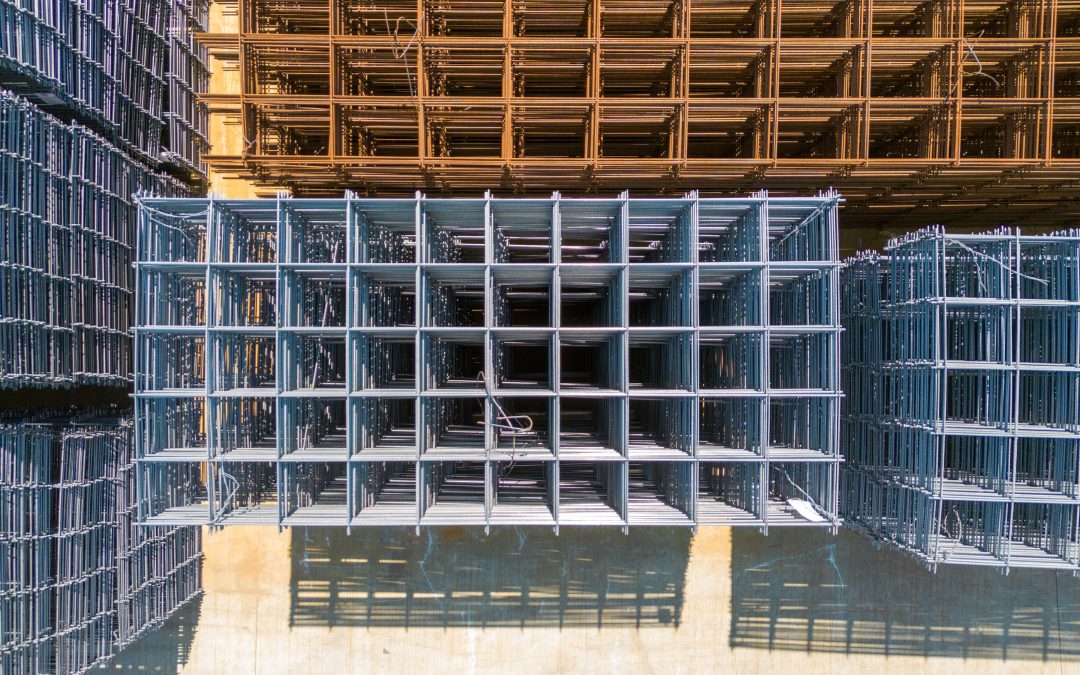
Welded Wire Reinforcement is manufactured by arranging longitudinal and transverse wires in a grid pattern and resistance-welding them at the intersections. The finished reinforcement must provide the dimensions and mechanical performance required for its intended application.
ASTM A1064 gives manufacturers, engineers, and buyers a shared reference for evaluating those characteristics.
Consistent Material Requirements
The standard establishes measurable requirements for the wire used in WWR. This helps ensure that the reinforcement ordered for a project matches the specified strength and material properties.
Reliable Weld Performance
The welded intersections help maintain wire spacing and transfer forces throughout the reinforcement. ASTM A1064 includes weld shear requirements that help evaluate the strength of these connections.
Dimensional Accuracy
Correct wire size and spacing are essential because they determine the steel area provided within the concrete. Established tolerances help ensure that the manufactured product remains consistent with the approved design.
Clear Product Specifications
ASTM designations give project teams a recognized way to communicate technical requirements. Instead of relying on general descriptions such as “wire mesh,” specifications can identify the exact material standard, wire size, spacing, and configuration required.
Stronger Quality Control
Producing WWR to a recognized ASTM specification requires manufacturers to monitor material properties, dimensions, and finished-product performance. This supports greater consistency across production runs and deliveries.
Does ASTM Certify Welded Wire Reinforcement?
ASTM International develops and publishes standards, but an ASTM designation does not automatically mean ASTM has inspected or certified a specific product.
When a manufacturer states that its Welded Wire Reinforcement meets ASTM A1064/A1064M, it means the product has been manufactured and evaluated according to the applicable requirements of that specification.
Buyers may request supporting documentation, such as certified test reports, when required by the purchase order or project specifications. These reports can provide information about the material and test results associated with the supplied product.
ASTM Compliance Is Only Part of the Specification
ASTM A1064 provides essential material and performance requirements, but it does not replace the project’s engineering documents.
A complete WWR order may also need to identify:
- Plain or deformed wire
- Wire size or steel area
- Longitudinal and transverse spacing
- Sheet or roll dimensions
- Required overhangs
- Placement requirements
- Applicable drawings or submittals
- Quantity and packaging needs
- Additional project-specific testing or documentation
Meeting ASTM A1064 does not mean every WWR configuration is suitable for every application. The reinforcement must also match the design prepared by the project’s qualified engineer.
What Buyers Should Confirm Before Ordering WWR
Before placing an order, procurement teams should verify that the supplier understands the complete project requirements.
Important questions include:
- Is ASTM A1064/A1064M identified in the project specifications?
- Does the required wire size match the approved design?
- Are the spacing and sheet dimensions clearly stated?
- Does the project require plain wire, deformed wire, or both?
- Are certified test reports required?
- Are there special tolerances, packaging needs, or delivery instructions?
- Can the manufacturer produce the required configuration and volume?
Clarifying these details early can prevent ordering errors, submittal delays, and material discrepancies.
Why Manufacturing Standards Matter
Concrete reinforcement is expected to perform as part of a larger structural system. Inconsistent wire properties, inaccurate spacing, or insufficient weld strength can create problems during inspection, placement, and construction.
ASTM standards give the industry a common technical language for evaluating these products. For Welded Wire Reinforcement, ASTM A1064 helps establish confidence that the material has been manufactured according to recognized requirements.
National Wire manufactures Welded Wire Reinforcement for construction, precast, infrastructure, and industrial applications. Our team works with customers to understand their specifications and provide WWR solutions manufactured to meet applicable ASTM A1064 requirements.
Need WWR (Welded Wire Reinforcement) for your next project? Contact National Wire to discuss your specifications, quantities, and delivery requirements.